
Exoskeletons that adapt to the task, and to the people who wear them.
Berel Technologies is a deeptech start-up born from robotics research. We develop the technologies behind tomorrow's exoskeletons, for every demanding field: construction, industrial maintenance, rail, agroforestry.
Start-up spun out of the Inria centre at Université de Lorraine · Patent application filed
The problem
Repetitive strain and overhead work cause musculoskeletal disorders (MSDs), the leading cause of occupational disease in France. Work organisation is reaching its limits, and the exoskeletons meant to take over are poorly adopted today, seen as a constraint rather than a help.
- 87%of recognised occupational diseases in construction are MSDs
- 298 daysof sick leave on average for a shoulder tendinitis (rotator cuff)
- €53,000average cost to the company for that same tendinitis
Sources: Assurance Maladie, key figures for construction (2018 data); DREETS Auvergne-Rhône-Alpes, COTEC MSD working papers (2019).
When a task can be neither eliminated nor mechanised, an exoskeleton can take over. But only if people keep it on.
The limits of today's exoskeletons
-
Passive exoskeletons
- Constant support, preset in advance
- Gets in the way as soon as the movement changes
- Shifts the strain to other parts of the body
-
Active exoskeletons
- Poorly managed, unintuitive control
- Heavy and power-hungry
- Hard to wear for a whole day
Our ambition
Towards smarter exoskeletons that are aware of their environment
X-HOLD grew out of our research on motion assistance. We are pursuing this work today with academic and industrial partners to develop new technology building blocks for tomorrow's exoskeletons: more intuitive, more aware of their environment, and able to understand both their user and the task at hand. Our ambition is to make the exoskeleton a true collaborative tool, rather than a constraint endured at work.
Adaptive
Fitting each person's build and the task in progress, rather than imposing a standard movement.
Intuitive
Assistance that is controlled naturally, without taking attention away from the work.
Efficient
Relieving effort at the right moment, with the energy efficiency a full working day demands.
Our R&D
A deeptech start-up, born from robotics research
- 5 yearsof research
- 3 generationsof exoskeletons
- 1 patentapplication filed by Inria, with the founders as co-inventors
- Inriathe Université de Lorraine centre, where we come from
An intelligent exoskeleton sits at the crossroads of three disciplines: mechanics, control and embedded artificial intelligence. Our team brings these three areas of expertise together to develop the technology building blocks that today's exoskeletons are missing.
Adaptive mechanics
A mechanism that follows the movement and adjusts to each user's build.
Control and assistance
Regulated assistance that supports effort at the right moment while staying energy-efficient.
Embedded perception
Understanding the user, their task and their environment, with voice control and no cloud connection.
We are not selling exoskeletons yet: we are building the technologies that will let exoskeletons deliver on their promises in the field.
The demonstrator
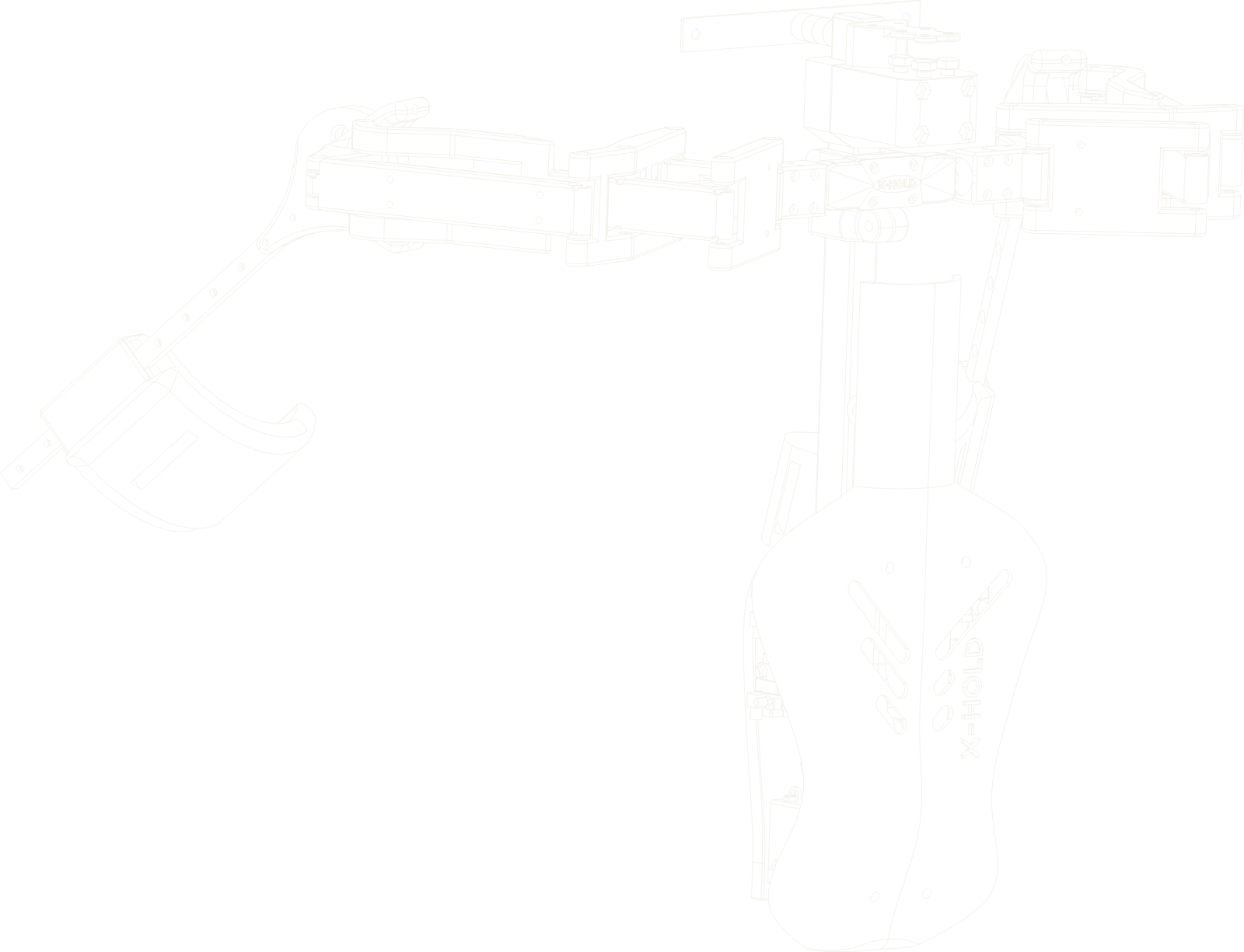
To move fast, we have developed a demonstrator derived from X-HOLD, our first exoskeleton. It is a test platform that lets us try out different technical solutions in real conditions and keep only those that work for users.
Where it started: X-HOLD
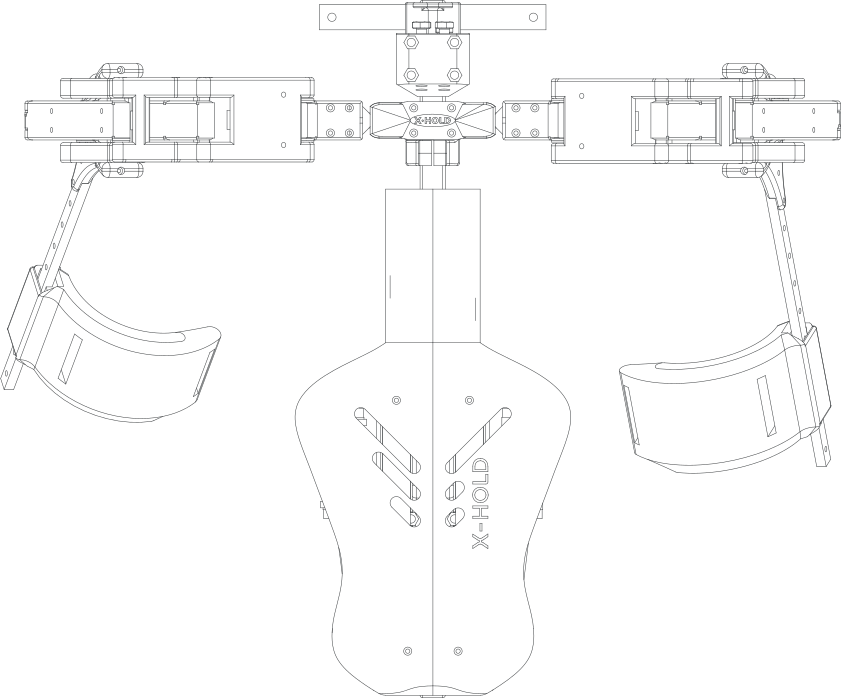
A semi-active upper-limb exoskeleton that relieves the shoulders during overhead work: on a construction site, in a maintenance workshop or out in the field. Its mechanism adjusts to the movement performed and to each operator's build. Voice-controlled, it can be operated hands-free.
Patent application filed
Our approach
Designing with the people who will use it
An exoskeleton is only useful if it is worn. That is why our future users are not the end of our design process: they are its starting point.
- Observe the movements, workstations and real constraints on the ground.
- Design technical answers to these needs.
- Prototype these solutions on the demonstrator.
- Test in real conditions, with operators.
- Iterate based on measurements and feedback, then start again.
Every piece of field feedback shapes our technical choices. We are preparing our first trials with companies that want to help build the exoskeleton of tomorrow.
Join the field trialsThe team
Three co-founders with complementary expertise, from the robotics teams of the Inria centre at Université de Lorraine.
-

Raphaël
LartotPresident
Mechatronics, control, electronics
-

Raphaël Bousigues
CTO
Mechatronics and mechanical design
-

Alexandre Oliveira Souza
AI expert
PhD in computer science, embedded perception
Our partners




Let's build it together.
Field companies, laboratories, investors: whether you want to test our solutions, collaborate on R&D or simply talk, write to us.
Company, supervisor, safety officer
Join the field trialsLaboratory, investor, partner
Get in touchor directly: contact@berel-technologies.com